Come venture to our new BUSHCARE KIDS resource page and find a range of activities that will enable you to discover, explore and enjoy nature around your backyard.
Also check the Blue Mountains City Council – Connecting with Nature Our goal is to inspire the next generation – by connecting them to our special Blue Mountains environment and fostering their natural love of nature. In a learning experience unique to our City within a World Heritage Area, we offer local students the opportunity to explore their local water catchment, learn why it’s special and take action to protect it.
Great news! We have added a new page – VIDEOS to our Bushcare website where we can showcase Blue Mountains Bushcare and volunteers, the environment, threatened species, how to and other interesting segments.
Keep an eye out as we expand the video library. For the time being have a look at videos showing Bushcare South Lawson Park, Popes Glen Wasteland to Wetland, Saving the Callistemon megalongensis, Threatened species in the Blue Mountains and the Turtle Island Habitat launch.
A research and citizen science project that catalogued fauna species within the Blue Mountains, has now been published online.
“The word has got around”. Costa Georgiadis was filming Gardening Australia at the The Gully where he endorsed the Blue Mountains Fauna Inventory Photo: Sandy Benson
The Blue Mountains Fauna Project Inventory was celebrated on 26 February, at a launch event that included informative talks by Anne Carey of Applied Ecology and Alex Callen from the University of Newcastle.
Over 16 months data was collected from publicly available records, from special interest groups such as WIRES and the Australian Herpetological Society, as well as from Blue Mountains residents for the project.
Blue Mountains Fauna Inventory is now online (see details below).
One of the 453 pages in the Fauna Inventory showing the Spotted-tail Quoll – includes description on habitat, feeding, breeding; a map showing locailty in the blue Mountains, record sightings and status.
For this inaugural version, the project collated over 300,000 fauna records from the community and fauna databases to create the first inventory of fauna in the Blue Mountains LGA.
Mayor, Cr Mark Greenhill said: “This inventory demonstrates the incredible array of animals we share our home with, and reflects what a privilege it is to live in a city within a World Heritage Area. People come from all over the world to experience our wilderness, our animals and our precious biodiversity.”
Residents were asked to record animal sightings through an interactive map on Council’s Have Your Say website. There, community members were invited to drop pins on the map with details of fauna sighted. Photos and video could also be uploaded, if the resident had filmed the animal. Community members also contributed via the project’s Facebook page. If this all sounds very contemporary, Researchers compiling the inventory also researched historical records including the writings of early European explorers.
The Inventory has revealed a spectacular menagerie of furred, feathered and scaled friends we share our Mountains home with. More than 450 different species, including 51 threatened species, were recorded within the Blue Mountains local government area. Notable resident sightings include the critically endangered Regent Honeyeater spotted in a Springwood backyard and a micro bat found in leaf litter by someone cleaning out their gutters.
This inventory is an extremely useful resource both now and into the future, as it gives us a benchmark to measure whether we are succeeding in supporting our biodiversity or failing our wildlife.
After the prolonged drought, unprecedented bush fires and flooding natural disaster this Inventory reminds us of both how vibrant, and how fragile our local environment is, and what is at stake if we fail to protect it and these animals.
Anne Carey from Applied Ecology, who produced the Blue Mountains Fauna Project Inventory Report, presented an engaging talk on the species listed in the Inventory and where in the Blue Mountains you are likely to find them. Alex Callan, of Newcastle University, talked about a frog conservation citizen science project and encouraged all present to help fight the decline of Blue Mountains frog species.
The Blue Mountains Fauna Project is a joint partnership between the Blue Mountains Bushcare Network and Blue Mountains City Council, with grant funding from the Greater Sydney Local Land Services. Thanks to the efforts from the Bushcare team for running the fauna project program, in particular Tanya Mein for setting the project up – conducting the fauna surveys over the mountains.
The fauna inventory enables us to learn more about what wildlife is in our local bushland and how you can help both as a conservation volunteer and an landholder. If you would like to know how to help our wildlife then contact Bushcare. https://www.bushcarebluemountains.org.au/join-bushcare/
Check out Blue Mountains Conservation Society – What Blue Mountains Fauna Is That? Its primary source of information is the Blue Mountains Fauna Inventory. You’ll find it here – https://www.bluemountains.org.au/fauna.shtml
5 years funding for weed controlArticle by Linda Thomas
Bushcare volunteers, form an important component of Council’s overall weed management strategy. However, there are many other interesting conservation projects that you may hear about or encounter in your local area.
Two new grants
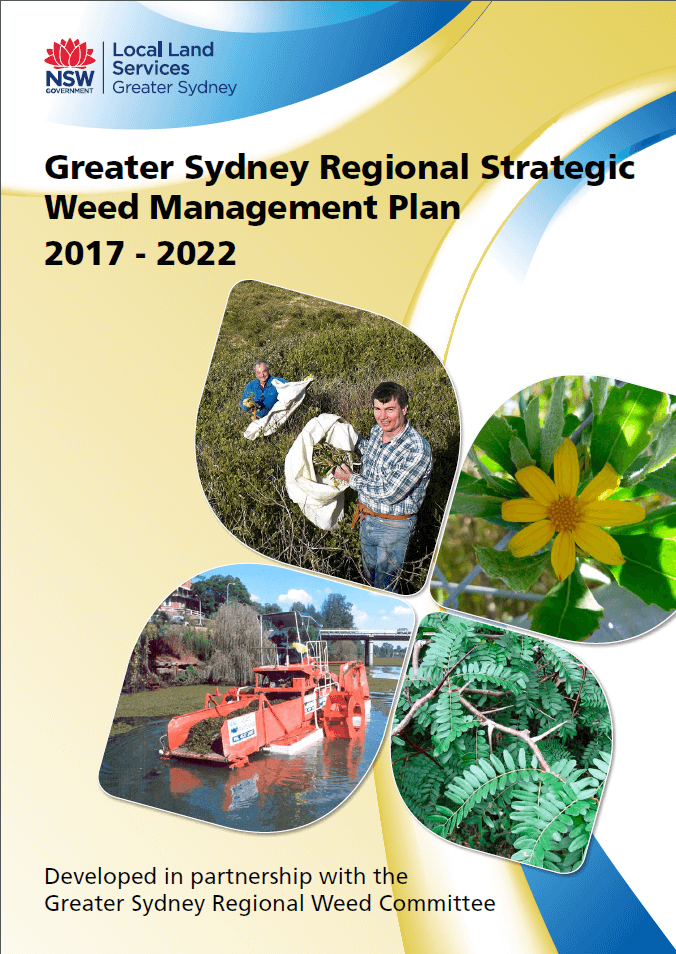
Council has received new grants from Greater Sydney Local Land Services and the NSW Environmental Trust which will help expand our capacity to deliver target weed control, bush regeneration and stormwater control outcomes over the next five years.
Each year Council’s Environment team applies for grants where grant program targets align with Council’s core program outcomes. In this way Council is able to extend its delivery of environmental programs within the Blue Mountains and increase the value of return for a rate collected dollar. As these funding sources are dependent on broader political climates, they cannot be relied upon to deliver core Council functions, but are an effective means of building capacity when an opportunity presents itself.
Most grants have a 12-18 month time frame, so these five year grants allow for the consolidation and extension of a range of programs to help target cross tenure issues across public reserves and private lands.
Himalayan Honeysuckle and Holly in Moist Basalt Cap Forest Mt Wilson Photo credit: Linda Thomas
Council will use these grants to:
Target Cats Claw Creeper in Springwood, Blaxland and Lapstone. This is a new priority weed which has limited distribution in the lower mountains. The aim over five years is to substantially control and eradicate all known populations of Cats Claw Creeper in our Local Government Area.
Extend ongoing programs to control Pussy Willow, Boneseed and African Olive in the mid to lower mountains.
Target bird spread weeds such as Himalayan Honeysuckle and English Holly on private properties in Mt Wilson, to protect Moist Basalt Cap Forest.
Extend bush regeneration programs in Blue Mountains Shale Cap Forest and Sun Valley Cabbage Gum Forest across Council reserves and adjoining private lands.
Monitor and trial controls for Bell Miner populations, which are linked to tree dieback in several lower mountains reserves.
Install stormwater control structures and extend weed control programs in several swamp systems in the upper mountains.
Support the Katoomba / Govetts Creek, Gordon Creek / Leura Falls Creek, and Jamison Creek catchment groups by undertaking extended weed control and rehabilitation projects on sites these groups have nominated as outstanding problems in their catchments.
From the 1st of July 2017 the NSW Government has replaced the Noxious Weeds Act 1993 with the Biosecurity Act 2015. Under the Biosecurity Act 2015, the Blue Mountains City Council, as the Local Control Authority, has a legal obligation to manage the biosecurity risk posed or likely to be posed by reducing the impacts of Priority Weeds.
WHAT IS BIOSECURITY?
Biosecurity refers to the protection of native plant communities; reducing the risk to human health: and the risk to agricultural production, from invasive weeds.
WHAT DOES THE NEW BIOSECURITY ACT MEAN FOR ME?
Under the Biosecurity Act, landowners have a responsibility to control the risk that Priority Weeds on their property pose to neighbouring bushland and properties.
Residents will see a change in the terminology used, for example, the term Noxious Weed will be replaced with Priority Weeds or Biosecurity Matter, and weed notices/orders will be issued as Biosecurity Directions under the Biosecurity Act. There are also some changes target invasive plants identified as Priority Weeds compared to previous Noxious Weeds lists.
Therefore the Noxious Weeds Classification of individual weeds is no longer correct.
Will the Biosecurity Act change the way Council manages weeds on private property?
No. Council’s Urban Weeds Program and the process for inspecting private properties for invasive weeds will continue unchanged. Council will also maintain its current approach to education and enforcement relating to invasive weeds. Council will maintain the current process for issuing Weed Control Notices. The main differences will be the terminology used and that Orders will be issued under the Biosecurity Act. They will be known as Biosecurity Directions.
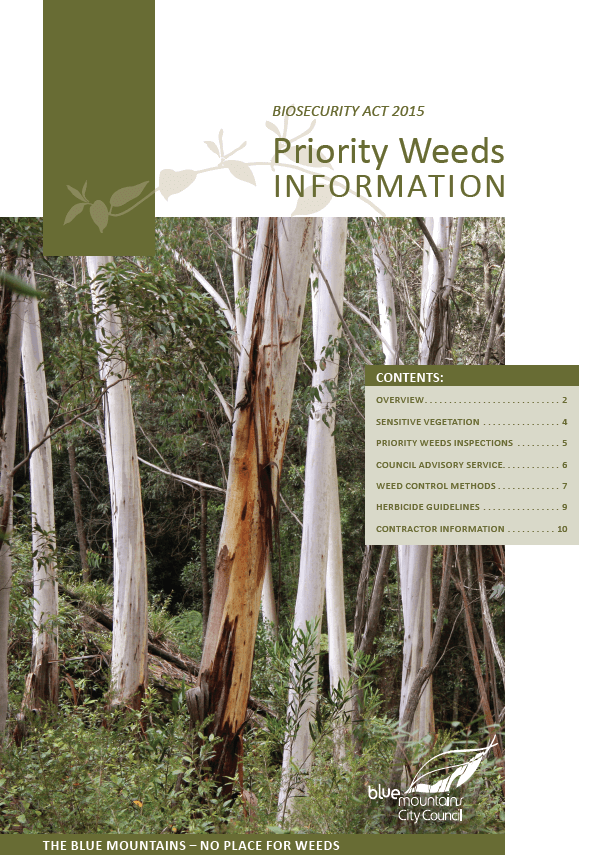
For further information on Priority Weeds in the Blue Mountains please download the Priority Weeds Information Booklet here;
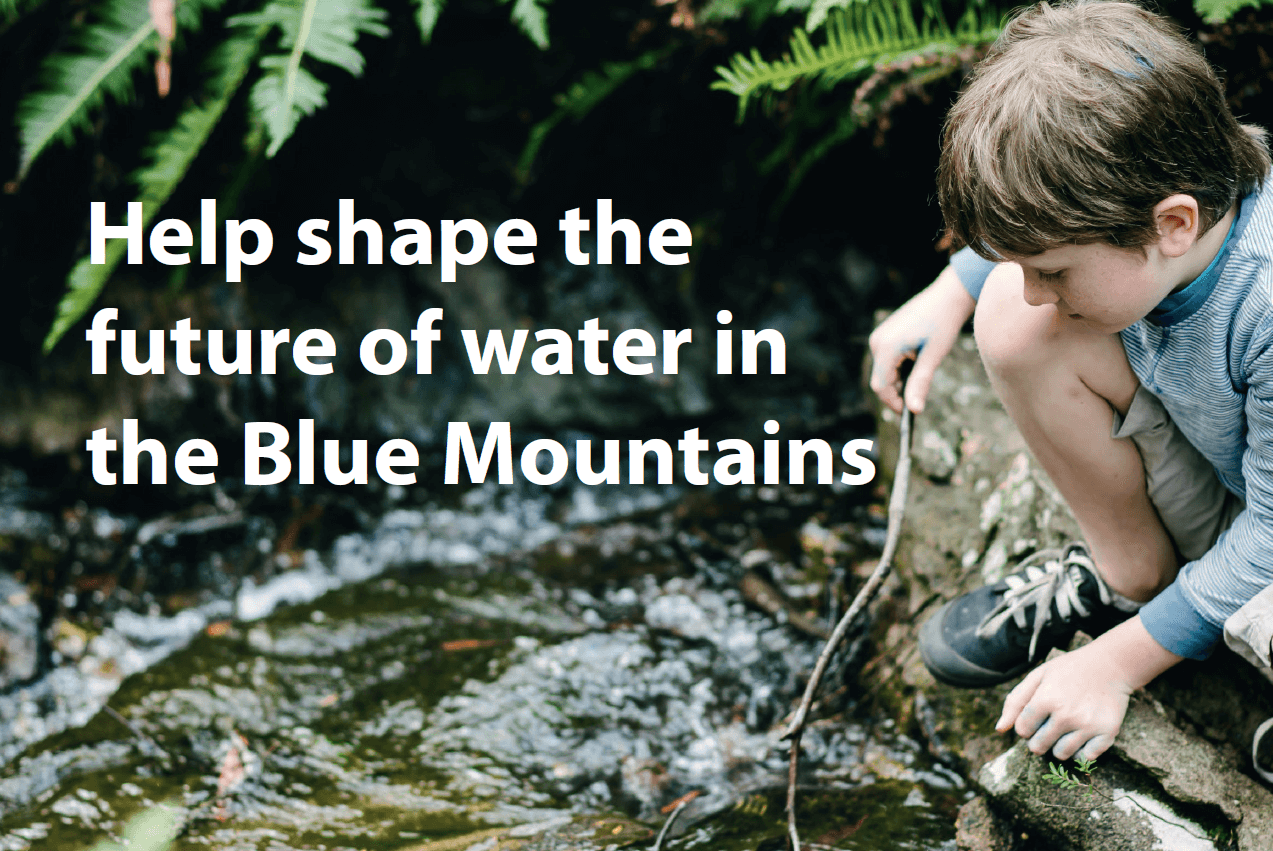
Help shape a sustainable water future for the Blue Mountains
Do you want our waterways to be healthy in the long term? To live in a place that is more resilient to heatwaves, drought, flooding and bushfire?
Our city faces significant challenges (such as climate change and urban development) that will have a big impact on our waterways and the way we use water. To secure a sustainable future, we need to rethink how we use and value water now. As a member of our local community, your knowledge and ideas are vital to this discussion.
Have your say
Council, together with Water NSW and the Cooperative Research Centre for Water Sensitive Cities, is running community workshops to help guide us towards a more sustainable, livable, ‘water sensitive’ future. This is an exciting opportunity for people from the community, government and business to get together and help shape our future. The workshops will be dynamic and interactive, exploring:
How we might benefit from a ‘water sensitive’ approach to development;
successful ‘water sensitive’ case studies from Australia and overseas; and
potential local projects to implement as part of Council’s new Water Sensitive City Plan.
You can choose a workshop time and location that suits you:
Do you have a swamp in your backyard or interested in swamp restoration?
Then come join us for this very special event in Hazelbrook, where you will learn the basic principles about swamp restoration whilst giving this swamp a helping hand.
The swamp is located off Rocklea Street, which is the very north end of the urban area and is still in its early stages of being restored, so there is plenty of primary work to be done on a variety of weeds – Erica, buddleia, privet, crofton weed.
A FREE delicious lunch and morning tea has been kindly donated by Hominy Bakery.
Bookings are essential so please RSVP via the link on this page or contact Stephanie at [email protected]. by Thursday 20 September.
Notice of intention to issue Licences for the use of BMCC managed lands for Organised Nature Based Recreation and Tourism activities for the 2017-2018 Licensing Year
This process will legitimise the ongoing use of these lands. The term of any such licence will not exceed one year and renewal is only available through reapplication.
Submissions need to be made by 5pm Wednesday 2 August 2017.